
Dave Campbell OBE
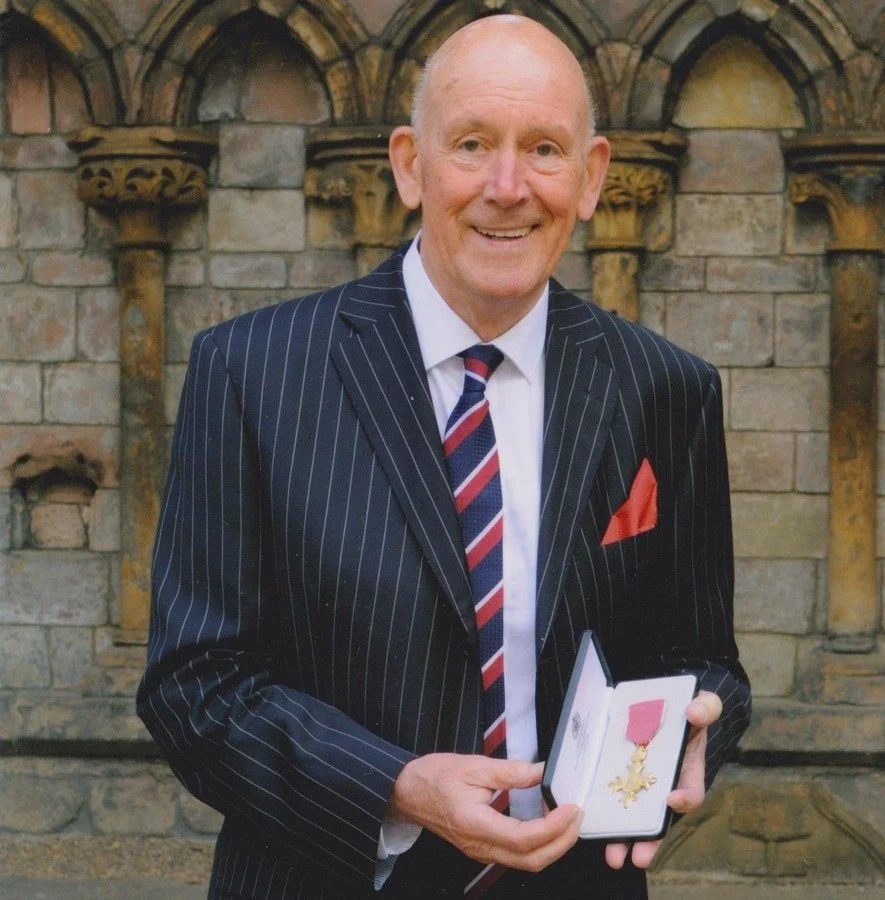
We are sad to announce the passing of Dave Campbell
David “Dave” Campbell OBE was one of the outstanding figures in Scottish athletics coaching: a coach, mentor, father figure and friend whose influence extended far beyond the running track.
Over more than half a century he gave thousands of hours of his time to developing athletes, some of whom went on to compete at the highest levels of the sport. Yet medals, championships and records tell only part of Dave’s story. His greater legacy can be found in the young people he helped shape and the lives he influenced.
Dave was born in Easthouses on 6 February 1936 and lost his father when he was only 12. His working life began at the Co-op, doing general store work, before he was called up for National Service at the age of 18.
He served for five years in the Royal Air Force, rising to the rank of Corporal — an achievement of which his family remain particularly proud. Sport was already an important part of his life. During his RAF service, Dave played football for Bad Zwischenahn in Germany, and later for Felixstowe Town in England.
After leaving the RAF, Dave worked for Lyles, a provident shop, before joining Reckitt & Colman and later Bulmers.
Dave was immensely proud of his career with Bulmers. He had a natural ability to build relationships, and many people who began as clients became close and lasting friends.
A Rangers and Manchester United supporter, Dave nevertheless developed something of a soft spot for Hearts — although his son David, the Hearts supporter in the family, recalls that any affection was quickly put to the test whenever Hearts played Rangers.
Dave was particularly proud of the part he played through Bulmers in getting the Strongbow sponsorship agreement with Hearts pushed through. It became a highly successful and enduring partnership and remained an achievement that gave him great satisfaction.
Dave’s journey into athletics coaching began in the 1960s.
At the time he was playing a great deal of football and, looking for a way to improve his speed on the pitch, began training with a running squad that held sessions at Newtongrange Star’s ground.
As injuries gradually curtailed his football, Dave competed himself on the professional running circuit. When the coach who had been taking the sessions at Newtongrange moved on, Dave stepped forward to take over. It was the beginning of a coaching career that would span more than half a century.
His athletes competed on the professional circuit at Border and Highland Games and, as the group developed, Dave began enjoying considerable success.
Among the names he spoke about most proudly from that generation were Rob Hall and Dave Curry, two outstanding athletes whom Dave believed could have held their own against the leading amateurs of their time. The strict separation then existing between professional and amateur athletics meant they were never given the opportunity to find out.
Dave’s son David experienced both sides of that divide himself, competing in professional and amateur athletics until he was caught doing so and found himself in a little trouble. Not long afterwards, athletics became open, removing the old distinction between the two codes.
By then David was around 13 and Dave increasingly began coaching younger athletes in the amateur sport. That eventually led to his long association with Edinburgh Athletic Club, one of Scotland’s most successful athletics clubs.
His contribution was entirely voluntary and his commitment extraordinary.
His regular coaching days were Tuesdays, Thursdays, Saturdays and Sundays, week after week, 52 weeks of the year. Training continued through Christmas and New Year and through Edinburgh winters. Rain, cold and snow were never reasons not to train.
As major national competitions approached, Dave would introduce additional sessions, sometimes taking athletes to six days of training out of seven. Even his annual holiday did not interrupt the programme. He made sure that I was there as his assistant coach, following the programme and instructions he had left.
Yet remarkably, very little of this needed to be said.
Commitment was an unwritten rule. Punctuality, hard work and dedication were simply part of the group ethic. Dave established that culture by example. He was there, week after week and year after year, and his athletes responded in the same way.
Dave was never a demanding coach in the conventional sense. He worked with his athletes. They understood that the hard work was for their own benefit and trusted the man guiding them.
In all the years I worked alongside him, I never once heard Dave speak an angry word to an athlete. He did not need to raise his voice to command respect. His authority came from the relationships he built, the confidence his athletes had in him and the example he set himself.
Dave’s results spoke for themselves. He had nothing to prove.
He was conscious that people looking in from outside might sometimes think his athletes worked too hard. Having worked alongside him for many years, I never believed that to be the case. Dave knew his athletes, understood what they were capable of and knew why every session was there.
Dave also had an exceptional eye for young talent.
I first met Dave in 2001 when he began coaching my son Chris O’Hare, who was then just 11. Dave recognised Chris’s talent almost immediately and coached him throughout his formative years until, at 18, Chris left Edinburgh for the University of Tulsa in the United States.
Chris became one of the first of Dave’s athletes to take the American collegiate route, becoming an NCAA champion and record-holder before going on to represent Great Britain at the Rio Olympic Games and at several World and European Championships. He became a three-time European medallist, winning two bronze medals and a silver during an outstanding international career.
Dave’s involvement with our family went much further. He also coached our other three children, Ryan, Olivia and Dominic, all of whom became Scottish national medallists. Olivia subsequently followed Chris to the University of Tulsa in 2012 as a student-athlete.
Brothers Josh and Jake Kerr similarly came under Dave’s guidance from the age of 11. Josh later followed the American collegiate route to the University of New Mexico, where he became an NCAA champion and record-holder before going on to become World 1500m Champion, an Olympic silver and bronze medallist, a two-time World Indoor Champion and world mile record-holder.
Another of Dave’s former athletes, Darren Gauson, took up the coaching baton himself, eventually becoming Head Coach of Track & Field and Cross Country at the University of New Mexico — the same university at which Josh had competed.
It is a remarkable thread running from Dave’s coaching group in Edinburgh into American collegiate and ultimately world athletics.
But the achievements of Dave’s most successful athletes tell only one part of his story. Every athlete mattered to him.
For every youngster who went on to compete internationally, there were many others whose achievements might have been measured in a first club vest, a personal best, a national final or simply becoming better than they had believed they could be.
Dave gave them the same commitment, encouragement and attention. Whether an athlete was destined for an Olympic Games or simply trying to improve, Dave worked with them, believed in them and encouraged them to believe in themselves.
Many came to him at 11 or 12 years old and remained under his guidance throughout some of the most formative years of their lives. Dave did much more than coach them to run. He helped shape them into young adults, teaching lessons of determination, resilience, self-belief and humility. His support was emotional as well as athletic and, for many, Dave became a father figure.
He helped in practical ways too. Through the friendships he had developed during his career with Bulmers, Dave knew the owners of many bars and businesses throughout Edinburgh and would often help his athletes find part-time work.
There was trust attached to a recommendation from Dave Campbell. If Dave recommended one of his athletes, people knew they were getting someone he believed would be a good and reliable worker. It was typical of him. If he could quietly open a door for a young person, he did.
Dave could be enormously confident in athletics, and to those who did not know him that confidence could occasionally be mistaken for arrogance, it wasn’t arrogance, Dave was a winner.
He believed in his athletes and in the work they had done together. His confidence came from experience and from results that spoke for themselves. But winning never came at the expense of the young person in his care. Dave was working with young people first and athletes second.
In 2019, Dave was appointed an Officer of the Order of the British Empire. The OBE was a particular source of pride to him and represented national recognition of an extraordinary contribution made over many years.
Yet for all his pride in athletics, his career and his OBE, his greatest source of pride was his family.
Dave met Joan when she was 30 and he was 36, and they married on 7 May 1977. Their son, David, was born on 6 January 1978. In time, Dave became the immensely proud grandfather of Bailee, Aaron and Leo.
Those of us who travelled with Dave to athletics meetings knew exactly how important his family was to him.
I spent countless hours driving Dave to competitions throughout Britain, sometimes as far as London and to virtually every major city in the country. There was rarely a quiet moment. Dave could talk from the moment we set off until the moment we arrived.
We talked about athletics, football, work and life, but frequently the conversation returned to Joan, his son David and his grandchildren.
Joan herself was a familiar companion on many of those journeys. Her support for Dave and for the extraordinary amount of time he devoted to athletics was constant. They were a partnership, and anyone who spent time with Dave could be left in little doubt about what Joan and his family meant to him.
My own relationship with Dave had begun simply because he was coaching my 11-year-old son. In time I became his assistant coach and had the privilege of working alongside him until his retirement from athletics in 2015. Somewhere during those years our relationship changed. The coach to whom I had first entrusted my children became one of my closest friends.
Dave’s relationship with our family endured long after the children had ceased to be young athletes turning up for training. He watched them grow into adults and remained part of their lives, sharing important family occasions with us, including the weddings of Ryan and Olivia in Edinburgh.
Looking back, I realise how fortunate I was. I saw at close quarters an outstanding athletics coach, but I also got to know the man behind the coach.
The medals, championships and records achieved by Dave’s athletes provide one measure of his contribution. The former athletes who went on to become coaches themselves and passed something of what they learned from him to another generation provide another.
But perhaps Dave Campbell’s greatest legacy is found away from the record books.
It belongs to all those athletes who trained under him across more than half a century — from the professional runners competing at Border and Highland Games in his earliest coaching days to the generations of young athletes who later came under his guidance in Edinburgh.
He gave them his time, his knowledge, his encouragement and his belief.
He coached athletes, but he helped shape people.
Dave helped produce champions. But that was never the only measure of his success, every athlete mattered to him.
And for those of us fortunate enough to have known him, worked alongside him and called him a friend, he will be very deeply missed.
Terry O’Hare
Friend and former assistant coach to Dave Campbell
Funeral arrangements
Dave’s funeral will take place on Wednesday 7 October at 10.00am in the Main Chapel at Mortonhall Crematorium, Edinburgh.
A reception will follow at Kings Acre Golf Course.
Dave’s family warmly invite his friends, former athletes and all those whose lives he touched to join them in remembering and celebrating his life.